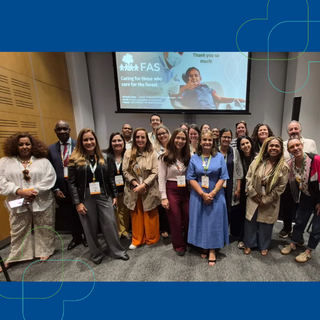
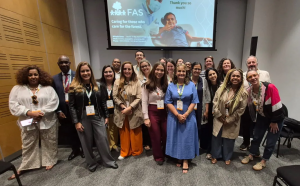
In Cape Town, South Africa, Beneficência Portuguesa, the Sustainable Amazon Foundation (FAS), the Institute of Artificial Intelligence in Health, the Institute for Health Policy Studies (IEPS), and ImpulsoGov presented Brazilian experiences focused on improving Primary Health Care and expanding access to healthcare in remote areas at the 18th World Congress on Public Health. All five organizations are part of the Together for Health initiative through the CARDIO, SUS in the Amazon, Noharm, Tributaries, and Impulso Previne projects, respectively, and participated in the event held in early September 2026.
Organized by the World Federation of Public Health Associations (WFPHA) and the Public Health Association of South Africa (PHASA), the congress brought together public health professionals, policymakers, and representatives of organizations and institutions from around the world. Under the theme “Health Without Borders: Equity, Inclusion, and Sustainability,” the program addressed issues such as health equity, Primary Health Care, sustainability, and the challenges of building more inclusive and resilient healthcare systems.
The CARDIO project, represented by Mariana Negrão Silveira, demonstrated how the initiative uses design thinking to translate scientific evidence into Primary Health Care practices, developing solutions alongside healthcare managers, professionals, and service users. The project aims to reduce morbidity and mortality associated with cardiovascular diseases by improving the quality of care in Primary Health Care. It introduces the CARDIO4Cities approach in municipalities across the Brazilian states of Paraíba, Ceará, and Pará, focusing on early diagnosis, appropriate risk management, and improved care management.
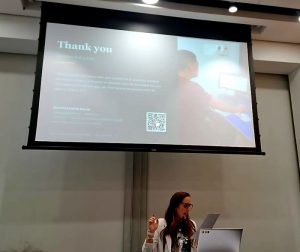
FAS was represented by Mickela Souza, manager of the SUS in the Amazon project. An abstract about the project was accepted for inclusion in the congress program, marking the organization’s first participation in the event. The presentation highlighted how FAS, as a civil society organization, supports public healthcare management in the Amazon region, particularly Primary Health Care in remote areas. It also showcased the organization’s broader work and the results achieved through the project.
“Having the SUS in the Amazon project accepted for this congress allowed us to bring the reality of the Amazon to an international public health forum. It was an opportunity to show how FAS supports municipal healthcare management in expanding health promotion and healthcare services in remote areas, while also exchanging experiences with professionals from different countries about solutions that could be adapted to other regions”, says Mickela Souza Costa.
Noharm was represented by manager Daniela Faccio, who shared the project’s experience within Together for Health. Her presentation demonstrated how Artificial Intelligence can support patient safety and strengthen clinical pharmacy services in Primary Health Care within Brazil’s Unified Health System (SUS).
“It was a highly meaningful opportunity to bring an experience developed in Brazil to an international forum for public health discussions, demonstrating how an initiative implemented on a large scale within SUS can use technology to improve the quality of care and promote safer medication use. Exchanges with participants from different countries and contexts also broadened the discussion about the potential of AI solutions developed specifically for the Brazilian reality”, says Daniela.
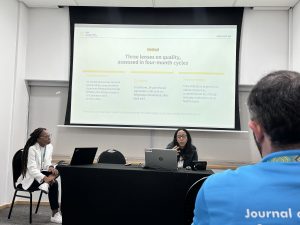
IEPS, in turn, organized the panel “Communication for Health Equity: Reaching Underserved Populations in Brazil Through Effective Strategies,” in partnership with ImpulsoGov and Projeto Saúde e Alegria (PSA). The panel featured a presentation of the Tributaries project, which operates in Primary Health Care in western Pará, a region shaped by the so-called “Amazon factor”. The panelists were Maria Letícia Machado (IEPS), João Victor Cavalcante (ImpulsoGov), and Eugenio Scannavino Netto (PSA).
During the session, the results of Tributaries project were presented, highlighting how the project combines clinical protocols, digital messaging, and connectivity to strengthen care for pregnant women and people with hypertension. Maria Letícia Machado, Public Policy Coordinator at IEPS, believes that “this type of exchange reinforces the importance of producing and systematizing evidence to guide more equitable and effective public policies.”